
Camping on a Maine Island

Updated: Aug 18
All you need is a tent, boat, and WAG bag.

Two of my "work days" last week included primitive camping on an island near Rockland. If you're new to this term, it describes staying in remote areas without access to potable (drinkable) water, bathrooms, or trash cans.
While primitive camping on the mainland, you'd dig a cat hole in the ground to dispose of human waste, but on islands, that is not allowed. The soils are too shallow and easily eroded and human waste becomes a biohazard. So, you have to pack in and pack out everything. Everything.
The solution is called a Wag Bag, short for Waste Alleviation and Gelling Bag. It's a puncture-resistant disposable bag that includes a NASA-developed gelling agents that traps, deodorizes, and breaks down waste. Once you've pooped in the Wag Bag, you seal it up and put it into a second bag, seal that one, and carry it out with the rest of your trash.
Maybe leading with this detail wasn't the best idea. But stick with me, because primitive camping on Maine islands is an experience worth having.
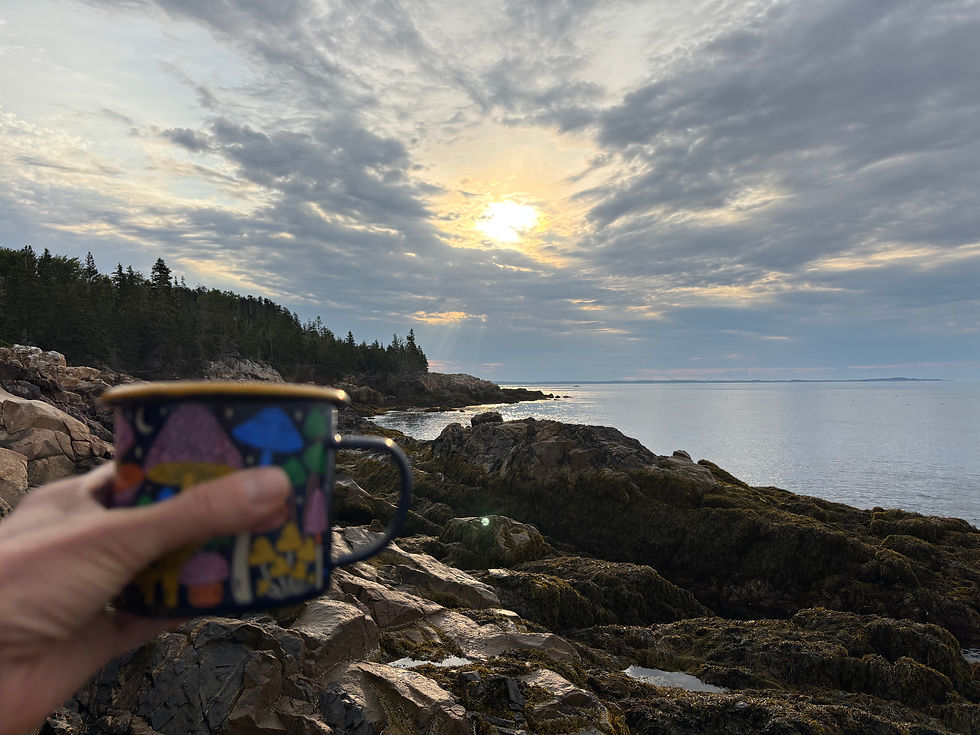
Why? Because you can have an island entirely to yourself. Picture falling asleep to the sounds of gently waves lapping the shore, then waking to a stunning sunrise on ocean cliffs, warm coffee in hand.
As part of my job with Teens to Trails, I sometimes join these types of trips for middle and high school outdoor clubs. This particular adventure was led by the Maine Island Trail Association (MITA), a membership-based nonprofit stewarding the Maine Island Trail: a 375-mile water trail connecting over 200 islands along the coast of Maine.
The islands, owned by private landowners, conservation groups, and federal, state, and municipal agencies, allow MITA members access to their properties, as long as they follow Leave No Trace and careful stewardship. MITA creates an annual guidebook, which offers details on accessing all of the islands along the trail, it's extensive and super helpful.
This was my first camping trip on a Maine Island, and it's opened up a new world of adventure ideas. As a hiker, I'm familiar with mountain trails leading to backcountry campsites, but water trails leading to island campsites is a new concept. The more I explore, the more I add to my list. Maine, you continue to surprise and delight me.
I'll share details on this island camping trip, but first, you'll need to find yourself a boat (obviously) to access the Maine Island Trail.
Our group met at the Snow Marine Park in Rockland, where we were able to leave our cars overnight. After loading our camping gear onto three motorboats, we headed to Monroe Island. It's about 15 minutes from the boat launch and across the bay from the Owl's Head Lighthouse.

Our captain Seth, who's also the Penobscot Bay Waterkeeper, told us to look for whales, since they'd been spotted around the bay all summer long. Despite my constant searching, we never saw one, but we were gifted several porpoise sightings...pretty spectacular.
Monroe Island is owned and managed by the Maine Coast Heritage Trust (MCHT). The 225-acre island includes six beaches, two campsites, and a two miles of trails winding through fields, forest, and scenic coastline.

Camping is permitted at the two established sites on a first come, first served basis. For groups of six or more, a permit is required and can be requested by calling MCHT at 207-729-7366.
We did visit nearby Ash Island during our camping trip for a stewardship project. For several hours, our group climbed over rocks and scoured the shoreline for trash. We collected six contractor bags worth, enjoying every minute of the rewarding endeavor.
After dark, we laid under a sky full of stars to watch the Perseid meteor shower light show. On Maine islands without electricity (like Monroe) there's very little light pollution and the amount of stars that can be seen from the dark sky is incredible. As I drifted to sleep in my tent, I heard some students return to the campsite to wake their friends. They'd discovered bioluminescence in the water and were excited to share the magic. It's not something you see every day...just another gift of Maine island camping.
For more information on Monroe Island, visit MHRT's website here. Find details on MITA and becoming a member here: https://mita.org


